As compared to my previous airline, instead of only having one aircraft to choose from, there were 9.
Airbus 320 Series
Airbus 330
Boeing 777
Boeing 767-400
Boeing 757
Boeing 747
Boeing 737
Boeing 717
McDonnell Douglas 88/90
With that long list of airplanes, how could I possibly choose? Well, fortunately or unfortunately depending on your perspective, that list was shortened for me when I showed up for Day 1. Of the airplanes on the list, the wide-body airplanes (two aisles instead of one), the ones that normally fly long international flights that cross oceans are very desirable. Only the most senior of pilots both First Officer and Captain, fly those. So, it was easy to cross B747, B757, B767, B777, and A330 off the list. It is going to be 10 years until I see the inside of one of those as a pilot. That left me with just the narrow-body aircraft to choose from. So, let's begin!
MD-88/90
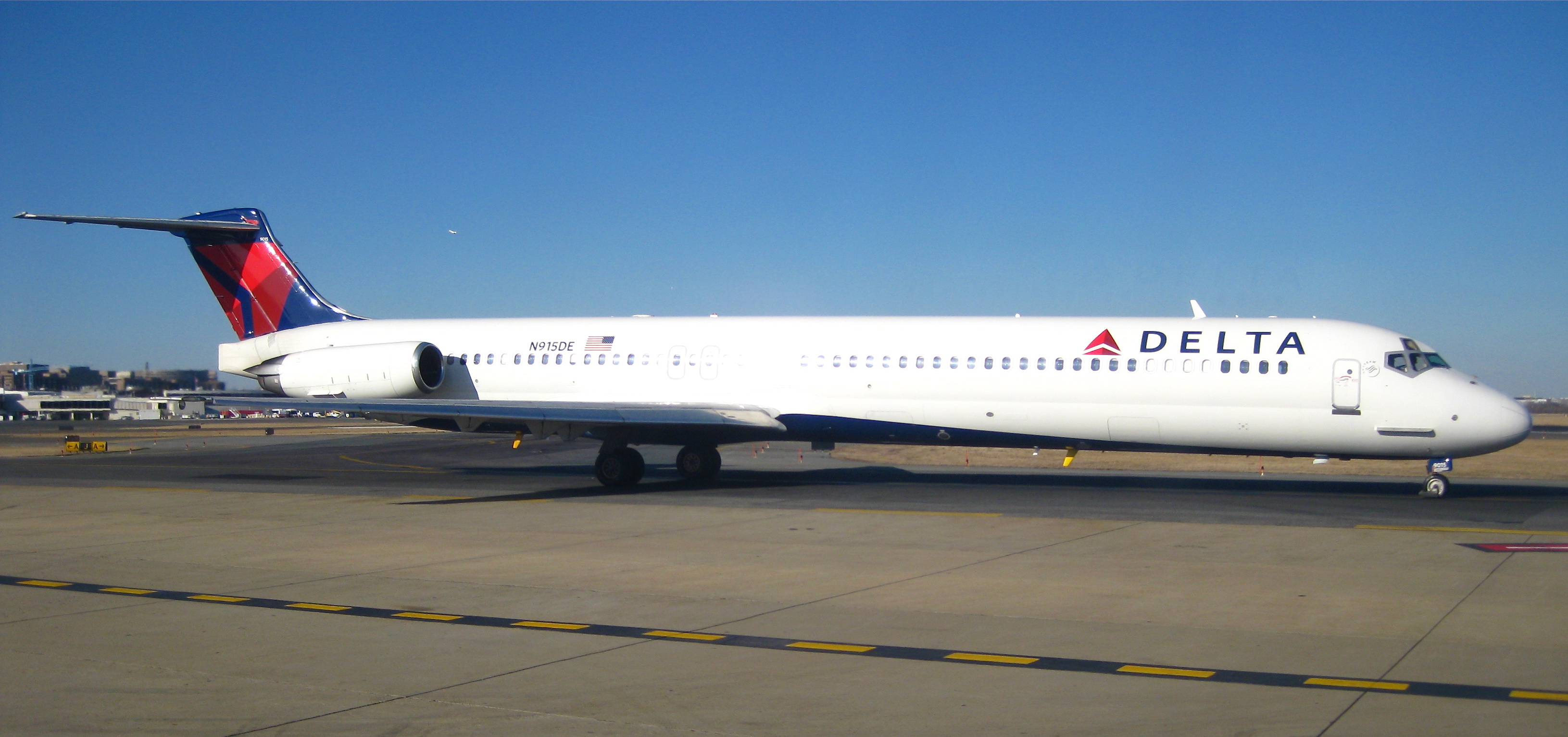
The MD-88/90 aircraft are very unique and easy to spot taxiing around an airport. Sporting a "T-Tail" design with two large tail mounted engines and very long fuselage, the 88s dwarf their regional jet cousins. From a passenger's perspective, it is immediately clear when you walk into the cabin that you're in an older generation aircraft. While the seats and interiors have been completely refurbished and redesigned over the years, the aircraft features an iconic 3 by 2 seating configuration in economy and noticeably older overhead bin doors and flight attendant/over head lighting buttons. If you have a seat behind the wing and near the engines, you'll also notice that it is a much louder airplane than the newest generation passenger aircraft.
At Delta, these aircraft are most often utilized domestically on high volume (large city to large city), short to medium length routes. For example, the majority of flights between Nashville and Atlanta are on MD88s with a scheduled block time of just over an hour. They occasionally also do longer large city pairings like Atlanta or Houston blocked at 2:30, or Minneapolis to Las Vegas at 3:30, but a large amount of flying is less than two hours.
From a pilot's perspective, what does this mean? Lots of legs and long days. A pilot, and oftentimes a junior pilot, will find himself flying 4 or 5 legs a day into and out of busy metropolitan airports. These types of days can be long and exhausting especially in the heat of summer. It is very similar to the flying I did at the regional airlines and while it was fun when things went well, when weather fell apart or the plane had a mechanical issue, thetrips turned into 14 hours on, 10 hours off.
Why would anyone ever choose to fly that airplane? Well, its downsides are often its upsides. Because it is such a work horse, pilots bid to fly a different airplane as soon as they can. The relative seniority within the MD-88 starts going up rapidly before you've even left training. Instead of being on reserve on weekends in NYC, a new pilot could hold a schedule of flying (called a line) and be off weekends within a few months of finishing training. This undesirability also means that the MD88 is also a little short staffed. If a pilot plays his cards right, even on first year pay, he could make more in a month than a 12-year Captain by volunteering to cover flying when there are no reserves left.
Finally, purely from a nostalgic standpoint, when you get checked out in a MD-88/90, you're really getting checked out in the Douglass Aircraft Corporation's DC-9 (DC-9-80). The MD-88 is really just a stretch version of the 1960s era DC-9 but developed after McDonnell and Douglas merged to become one company You are flying an airplane that was designed not long after the Korean War to usher in the jet age and signaled the beginning of the end of propeller driven commercial aircraft. On your license is forever stamped the authorization to fly a "DC-9," an airplane from a bygone era.
B-717

At first glance, you might say, "Chris, why did you post a picture of the airplane you just did a history term paper on? Well, fasten your seat-belts, ladies and gents, because this trip back through time rattles on.
Enter: the Boeing 717. Following the development of the MD-88, McDonnell Douglas went back to the drawing board and tried to develop a new aircraft that would replace the aging DC-9 to become more competitive in the 100 seat market.
The MD-95 project almost didn't get off the ground. Following Boeing's acquisition of McDonnell Douglas, the MD-95 was almost cancelled. However, due to a solid order by AirTran Airways, they decided to continue and re-designated the airplane the B-717. In 1999, Boeing began delivering 88 aircraft to the discount carrier who would then become the largest 717 operator in the world.
In 2010, competitor Southwest Airlines bought AirTran primarily for their strong presence in Atlanta and access to their international destinations in an effort to easily expand beyond the United States. Southwest, whose business model revolves around lowering costs by only operating one type of aircraft, the B-737, immediately began to look to off-load the 717. Delta, fresh off a merger with Northwest Airlines, jumped at the opportunity to replace Northwest's now approaching 50 year old DC-9s as well as the overabundance of fuel-inefficient 50-seat regional jet aircraft. They reached an agreement in 2013 to sub-lease all 88 aircraft as long as Southwest footed the bill for their $100 Million refurbishment.
To a passenger, there really isn't much difference between the MD-88 and B-717 in their exteriors. The B-717 is a much shorter aircraft and looks stubby compared to its older brother. The interiors look significantly newer but still feature the 3 x 2 seating. In my opinion, it's a much quieter and much more comfortable experience compared to the MD-88.
To a pilot, the differences stop at the door. Even though the B-717 is officially a variant of the 1964 DC-9, the cockpit is nothing like the original. The flight instruments are fully computerized and all the old gauges and dials from the MD-90 have been replaced with a single computer screen. It was designed as a modern airliner in the shell of its era defining old man. The 717, however, was added to the Delta inventory to replace regional jet flying and fill the void left by the DC-9. Consequently, its more of the 4-5 leg days like with the MD-88 only there isn't the same nostalgic appeal as there would be flying the dinosaur.
A320 Series

The A319, A320, and A321 initially conceived in the late 1980s by European conglomerate Airbus is one of the fastest growing fleets at Delta and was another game changer in the airline industry. It was the first ever "fly-by-wire" system to be developed for commercial use. In every airplane developed before it, the flight controls (yoke and rudder) were physically connected by pulleys and cables directly to the wings and tail. As airplanes got bigger and faster, hydraulic systems were attached, much like the power steering in a car to aid in moving the flight controls. Still though, when the pilot moved the yoke, he was physically moving an aileron. With a "fly-by-wire" system, the pilot uses a joystick in the cockpit to tell a computer what he wants to do. The computer then tells the flight control computers how much to move the ailerons or rudder. Fun fact: the Airbus is the only domestic aircraft to feature a fly-by-wire system. Yes, all the others, including regional jets, still have pulleys and cables.
As a passenger, if you've flown domestically in the last 10 years, you've most undoubted flown on an A320 family aircraft. They are prominently featured at every major US airline with the exception of Southwest. It's a little harder to spot one of those flying or taxiing around but with a well trained eye, you could notice the opening of the engine inlet slopes rearward from top to bottom. Airbus aircraft also have very distinct nose section shapes. That's really about it.
As a pilot, this aircraft is wonderful to fly. Aside from the complicated computer logic accompanying the revolutionary flight control system, it is a fairly easy airplane to learn and master. The cockpit is roomy and comfortable compared to the more industrial Boeing and McDonnell Douglas aircraft. One of the greatest aspects of Airbus aircraft was in their design philosophy. Airbus, which currently has 3 classes of aircraft, designed their cockpits to be almost identical. The A320 (domestic narrow-body), the A330 (medium range international wide-body) and the A350 (long-range international wide-body) aircraft have very few differences in how the airplane flies and its systems operate. A pilot could fly his entire career in an Airbus and never have to completely re-learn an aircraft.
This would be my number one choice going into training. Unfortunately, out of the 33 of us in training, only one was available and it was chosen first. I was 5th to pick. Along with it being a comfortable aircraft to fly, it also flies longer legs.
B-737

My number two choice and the aircraft I ended up with is the Boeing 737. The original 737-100, originally designed by Boeing as a short-haul aircraft with only 61 seats, was to serve "thin markets" where it was impractical to bring in larger jet aircraft of the time. As a comparison, the smallest regional jet aircraft today seat 50. After consultation with its only interested customer, Lufthansa, an order for 21 aircraft was placed with the stipulation that they have at least 100 seats (large regional jets have 80). With this small order, Boeing, hoping just for a "gap-filler" aircraft, inadvertently developed the single most successful commercial aircraft of all time. How successful you ask? Over 9400 aircraft have been delivered since 1968 with 4400 still yet to be delivered. In fact, there are so many 737s around the world, on average, 2000 are in the air at any given time with one taking off or landing every 2 seconds.
The 737 has changed and been re-engineered appreciably since the first 737-100 was delivered in the late 60s. In fact, there are 4 generations of 737 aircraft, Original, Classic, NextGen, and MAX. Check out this picture of one of the first ever built and tested by NASA.

When the 737 was first designed, engineers attached the engines directly to the underside of the wing. One thing you might notice about the NASA aircraft is how long the engine is. This jet engine, called the low-bypass turbofan was the original jet engine of the day. It was extremely loud and very fuel inefficient, especially at low altitudes. What is a low-bypass turbofan? Original jet engine technology propelled aircraft primarily using a very fast jet of hot hair exiting the jet engine. It is very similar to the way a balloon is propelled when you let go of the opening after inflating. Unfortunately, at lower altitudes, in order to accelerate enough air to propel an aircraft, a significant quantity of fuel needed to be used. Additionally, the interaction of the hot, high velocity air with the cold, stagnant air of the atmosphere caused significant noise.
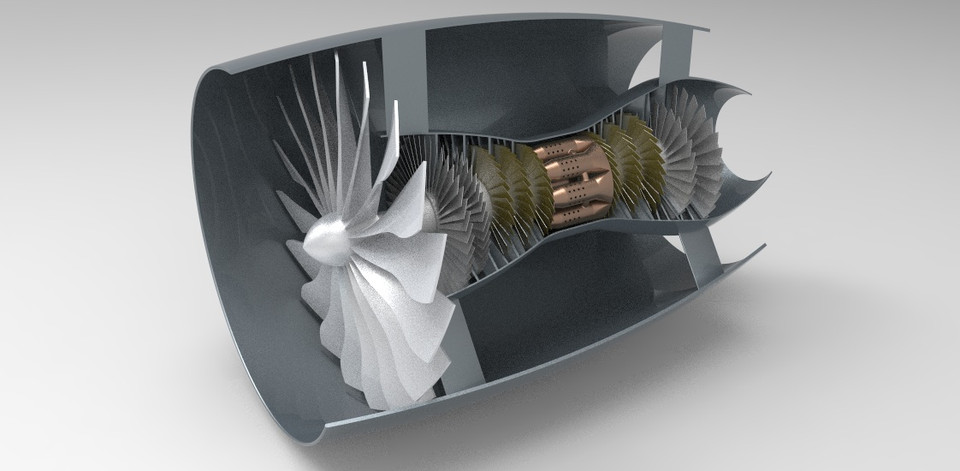
As jet-engine technology improved, a high-bypass turbofan was created (see: below). The main fan on the front of modern aircraft, the one that you can see spinning from your seat at the gate, is actually just a very large propeller powered by a much smaller jet engine. This fan pushes a large quantity of cold air bypassing the engine core to meet the hot jet of air at the rear where mixes before exiting the engine. This advancement in technology allowed for significant gains in fuel efficiency especially at low
altitudes. The mixing of cold and hot air at the rear of the engine (think muffler) also lead to a much more quiet engine.
Boeing began to design upgrades to its 737 aircraft using high-bypass turbofan technology creating what would eventually be dubbed, the 737 Classic (Models -300, -400, -500). Many of these are still being flown today by domestic carriers Southwest and Alaska.
One of the drawbacks of retrofitting the original design with new, large fan engines, was engineering around one of its key advantages, the short landing gear. There just wasn't the ground clearance below the wing to fit the new engines without creating enough differences that the FAA would require a different set of pilots to fly the aircraft. So, Boeing had its engine manufacturer move an accessory box from below the engine to the side, creating the unique, almost flat looking, engine.

Inside the cockpit, the Classic model changed very little. There was still overwhelming amount of round dials almost completely devoid of computer technology. In its next upgrade, Boeing would update most of the cockpit.
When Boeing created the Next Generation, the models you are most likely to fly on today and the model I fly (-700, -800, -900), they overhauled much of the instrumentation in the cockpit. Almost all of the round dials for engines and navigation were replaced by computer monitors. The overhead panel, controlling much of the supporting systems (A/C, electrical, hydraulic), wasn't changed at all. This was intentionally omitted so a pilot qualified on one generation of 737 would be qualified on all, resulting in much lower training costs for customers, specifically Southwest Airlines which operated a large quantity of 737 Classic aircraft.
In terms of pure nostalgia, this outdated overhead panel is both work intensive and also neat. It has some of the old 1960s era technology coupled with modern avionics. For example, on the regional jet I flew that was designed in the late 90s, almost everything was done by computers. After starting the engines, the checklists we ran just had us verify that everything transfered as normal. The 737, not so much. After starting the engines on this aircraft, I do the following: transfer power from auxiliary power unit to each individual engine, turn on center tank fuel pumps if above a certain fuel quantity, turn on external probe heaters, turn on air-conditioning, turn on engine bleed valves, turn off auxiliary bleed, set isolation valve from open to auto, turn off auxiliary power unit, run systems test to check for errors, and finally adjust and verify A/C settings.
With this history term paper coming to an end, I have to say that I am happy with the aircraft I chose. I fly longer legs and get to go to places countries in the Caribbean and South America. If I'm lucky, maybe one day I'll get to fly one of the trips from the West Coast to Hawaii. It's an aircraft I see myself staying on for awhile and I can't wait for what the future holds.

No comments:
Post a Comment